

Access For All Grant Programme
Making our landscape open to everyone, regardless of age, ability or background.
The 2019 Landscapes Review, led by Julian Glover, called on the government to ensure our National Landscapes could be enjoyed by a more diverse audience.
In response, the Department for Environment, Food and Rural Affairs (Defra) allocated £14.5 million towards making protected landscapes, National Trails, forests and the wider countryside more accessible for people of all ages, abilities and needs. As part of this, the North Devon Coast National Landscape has received additional funding from Defra for capital spend to make our protected landscapes more accessible to people of all ages and abilities, and from all backgrounds.
We have received an additional £63,000 of Government funding from Defra in 2026/27 and are seeking expressions of interest and applications for projects. We would love to hear from you! The funding guidance, eligibility criteria and application form are further down this page.
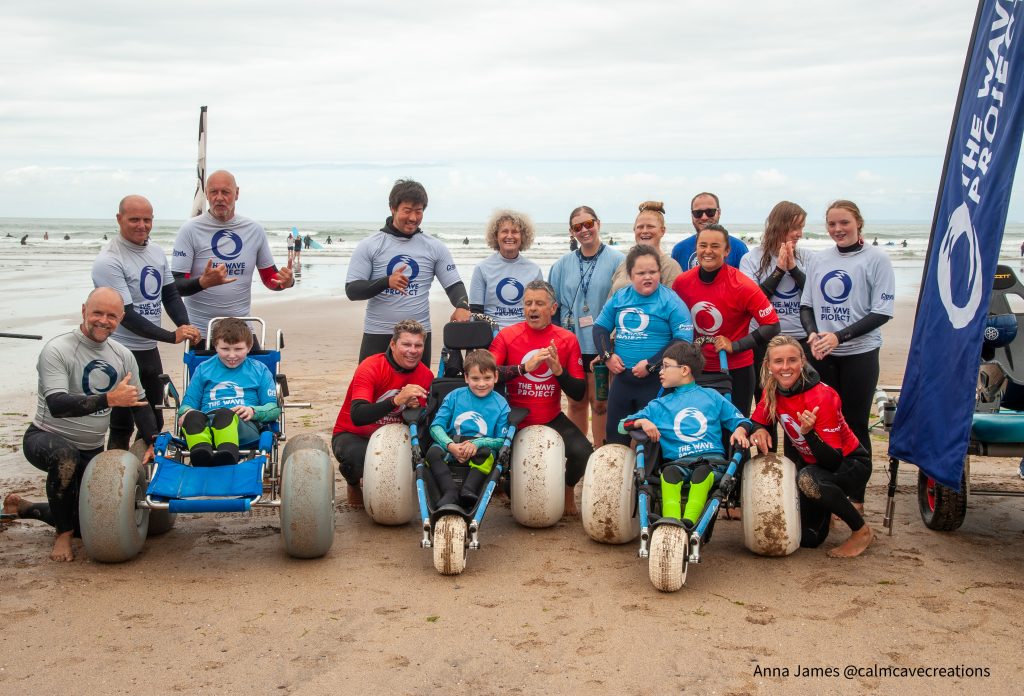
Public, private, voluntary and community groups can apply for Access for All funding; individuals and businesses can also apply if they can demonstrate their project will improve public access to and within the Blackdown Hills National Landscape for people of all ages and abilities and from all socio-economic backgrounds.
Access for All applications are appraised and evaluated for suitability against the funding criteria.
Projects must improve public access to and within the North Devon Coast National Landscape
The projects must be for capital expenditure. Capital expenditure is a one-off itemised cost where funding is provided to purchase or invest in a physical/digital item or asset to improve accessibility for all. Some examples of what would be classed as capital expenditure, include access infrastructure, buildings, machinery, and equipment, for example
- Disabled toilet facilities.
- Replacement of gates.
- Additional seating areas.
- Improved access to waterways for the mobility-impaired.
- Widening and resurfacing of paths for multi-user use.
- Purchase of trampers, mobility scooters, electric bikes, and storage/charging facilities.
- Purchase of specially adapted tools and personal protective equipment for volunteers.
- Provision of accessible signage and visitor information, physical and digital.
- Creation of a new or improvement of an existing piece of access infrastructure, such as building a toilet or fitting a new accessible gate or adapting a minibus or visitor centre.
- Research and development, defined in budgeting guidance as “creative work undertaken on a systematic basis to increase the stock of knowledge, and use of this stock of knowledge for the purpose of discovering or developing new products, including improved versions or qualities of existing products, or discovering new or more efficient processes of production”.
Some examples that are not classified as capital expenditure:
- Removal of a stile, unless it is being replaced by an accessible gate.
- Hire of a minibus.
- Staff time that is not directly attributable to creation of an asset
- Consult with disability representatives for any planned works.
- Adopt a pan-impairment approach and consider what the barriers to access are for all disabled people.
- Any accessibility infrastructure change or intervention should be accessible for all users and, where possible to do so, should avoid the requirement of extra tools to use (for example, gates locked with Radar keys) and consider safety, value for money, and sustainability.
- Spend must improve public access to and within the protected landscape and should serve the broader interests of the grant recipient and their communities.
- Funding for each project application should be between £2K and £20K. However, increased funding may be considered, in exceptional circumstances, depending on the scale and likely impact of the project.
- We encourage you to consider match funding for your proposal, either in kind or in cash, as this will be considered in the assessment of your application. Although we will consider 100% funding if the project is exceptional.
- Payments are made on completion of the project and not upfront.
- Access for All cannot fund work carried out before the date of the offer letter.
- Any planning permission or consents must be in place when you apply.
- The granted funded work must be delivered and paid for in 2025/26. All works must be complete and invoiced by 15 March 2026.
- Successful projects will need to comply with the grant’s terms and conditions which will be sent out with the grant offer. The terms and conditions stipulate a minimum level of publicity and completion of a short project summary form within 30 days of completion of the project.
- Download the Access for All application form [Word Document]
- Complete the form using the checklist on the application form to assess whether your proposed project meets the criteria.
- Once completed, email your form to [email protected] or post your application to the National Landscape office.
Your application will be assessed against the Access for All fund criteria.
We aim to have a decision within 21 working days from the date of receipt of an application that has supplied all relevant information to enable it to be assessed.
Grants are being awarded on an ongoing basis and will be awarded on a first come, first-served basis.
Got a project in mind?
We would love to know if you have a project that fits the criteria. If you’re unsure, or would just like to discuss an idea, then please email an outline to our Project Officer, Laura who will get back to you with further guidance. [email protected]